Airflow is politics.
Everyone acts like a firewall build is “pick a CPU, add NICs, ship it,” but the case decides whether your box runs at 62°C all day or cooks itself into weird packet drops, because fan placement, intake impedance, and drive cage geometry quietly set your thermal ceiling long before BIOS tuning ever gets a vote.
Want to bet your perimeter on vibes?
I’m going to be blunt: most “network appliance chassis” shopping is cargo-culting. People overpay for a badge, underpay for serviceability, then act surprised when a 1U mini-ITX chassis turns into a 3AM noise generator in a cramped MDF closet.
So let’s do it the hard way. The useful way.
The uncomfortable context nobody budgets for
Three words: attackers love edges.
Perimeter devices are getting hammered, and not in a theoretical way—CISA literally warned in January 2024 about active exploitation of Ivanti Connect Secure / Policy Secure gateway flaws (CVE-2023-46805 and CVE-2024-21887), with the subtext being: patch fast, restore fast, swap hardware fast if you have to. That’s not “security news,” that’s hardware operational design for firewalls. According to CISA’s alert, this was active exploitation, not a lab curiosity.
If your case makes a drive swap or a PSU swap a knuckle-splitting event, how fast are you really recovering?
And the pressure isn’t only technical. The paper trail is tightening.
The SEC’s July 26, 2023 rule requires public companies to disclose material cyber incidents on new Form 8-K Item 1.05, generally within four business days after materiality determination—meaning downtime and incident response are now tied to legal exposure and investor scrutiny, not just angry IT tickets.
Do you want a chassis that slows recovery when the clock is literally regulated?
Then there’s the raw loss signal.
In April 2024, the FBI’s San Francisco field office summarized the IC3 2023 numbers: 880,418 complaints and potential losses exceeding $12.5 billion, with California leading in both complaints and losses—translation: the “SMB edge firewall” is not a sleepy corner anymore, it’s where money goes to die when basics aren’t done.
Still think the box can be an afterthought?
Start with the deployment reality, not the spec sheet fantasy
Here’s my working rule: pick the case based on where it lives, then back into cooling, then back into motherboard/NIC selection.
Scenario A: Rack, shallow cabinet, “I need this in 1U”
If you’re building a pfSense/OPNsense rackmount case and you want 1U density, you’re buying constraints. Own that.
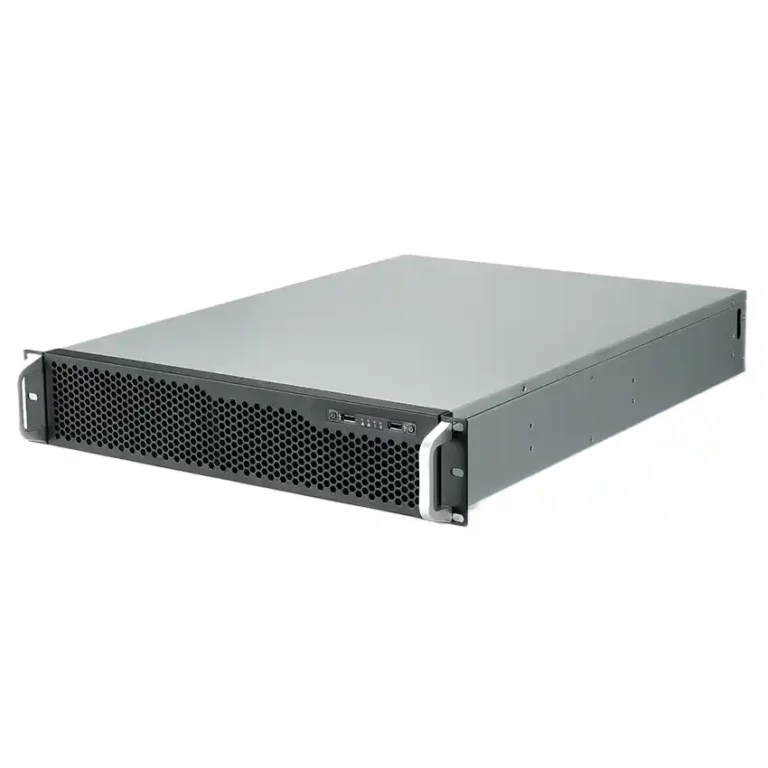
On IStoneCase’s side, their 1U server case lineup is explicitly positioned for “compact firewalls, routers, and SD-WAN appliances,” and they publish the mechanical facts that actually matter: SGCC steel (often 1.2 mm), multiple 40 mm fan arrays, and mini-ITX board support in specific models. Start there and compare like-for-like: depth, riser clearance, fan size, and PSU type. 1U server case options for edge firewalls and routers
Hard truth: 1U works when you accept that the thermal strategy is high static pressure, not “quiet.” Four 40×20 mm or 40×28 mm fans will move air through a dense fin stack, but they’ll also telegraph every dusty filter and every cable you route stupidly.
Scenario B: Wallmount / closet / branch office (the “hands-off” install)
Short depth wins.
Edge installs land in shallow cabinets, weird alcoves, and “temporary” wall racks that become permanent; that’s why short-depth server chassis choices are less about aesthetics and more about whether you can open the door, access ports, and not kink cables into failure. IStoneCase even says the quiet part out loud: shallow cabinets + tight clearances, and you need service access without drama. Wallmount chassis use cases in edge and low-voltage environments
How many times have you seen an install where the Ethernet patch leads are the load-bearing structure?
If your environment is dusty or public-facing, look at chassis designs that bake in physical protection—like removable dust filters and lockable panels. Their 2-slot wallmount cases list dust-filter panels and mini-ITX support in the category datasheet rows (that’s rare to see published clearly). 2-slot wallmount cases for compact network setups
Scenario C: Desktop / shelf / “quiet-ish” appliance
This is where “fanless mini-ITX case” searches usually come from.
But fanless is a promise with fine print: if you’re pushing >35W sustained CPU package power, plus a hot 10GbE PHY, and the box is in a warm closet, fanless becomes a slow-motion failure generator.
I’m not anti-fanless. I’m anti-lying. If you go fanless, spec the CPU (think Intel Atom C-series / low-TDP embedded parts or similar), control the NIC heat, and plan for real heatsinking contact surfaces. You’re buying conduction. Not hope.
The mechanical checklist I actually trust
Cable geometry matters.
A mini-ITX server case can be “compatible” on paper and still be a mess when you add a PCIe NIC, an M.2 2280 SSD, and front I/O, because the bend radius of power leads and the height of heatsinks collide in tiny volumes; that’s why I care more about internal layout diagrams than marketing photos.
Ever tried to close a lid over a stiff 24-pin ATX lead that refuses to behave?
Here’s what I verify, in order:
- Depth + rear clearance: if you’re in a rack, don’t just match chassis depth—account for power plugs, SFP+/DAC bend radius, and strain relief. If rails are involved, you need honest rear clearance too. The moment your build is “service-heavy,” rails and cable slack become uptime features, not accessories. Guide rail practices for short-depth rackmount cases
- Cooling topology: 1U = pressure; short-depth = compromise; desktop = mixed. Fan size tells the truth. Four 40 mm fans behave differently than a single 80×25 mm or 120 mm fan. Filters are great until they’re neglected.
- PSU strategy: FLEX PSU vs external 12V brick vs 1U PSU. FLEX can be convenient, but it also increases cable bulk in tight cases. External 12V can reduce internal heat but adds a failure point outside the chassis.
- NIC fitment: Intel i225-V and i226-V are common for 2.5GbE; 10GbE options often run hotter (and sometimes need airflow directly across the controller). If you’re using a PCIe NIC, confirm riser orientation and bracket height.
- Material + finish: aluminum (often anodized with an Al₂O₃ surface layer) sheds heat differently than steel, but design dominates material. Still, published thickness (like 1.2 mm aluminum) is a nice signal that the chassis won’t flex like a soda can.
If you want a concrete baseline example, look at IStoneCase’s ISC ITXS21 M: 280(W)×230(D)×88.9(H) mm, 7″×7″ board support, FLEX PSU, an 80×25 fan, and a single PCIe slot. That’s the sort of spec list you can actually build from, not just admire. ISC ITXS21 M aluminum Mini-ITX case specs
And if you’re still browsing broadly, their Mini-ITX case lineup page is a clean hub that shows multiple form factors and a category datasheet table—useful when you’re comparing bays, power options, and expansion constraints quickly. Mini-ITX cases and configuration table
Quick comparison table: what you’re really buying
| Case type | Where it wins | What breaks first | Typical build profile | My blunt recommendation |
|---|---|---|---|---|
| mini-ITX rackmount case (short-depth) | Branch racks, shallow cabinets, “fits anywhere” installs | Rear cable crush, airflow starvation if packed tight | 35–65W CPU, 2–6x GbE/2.5GbE, optional PCIe NIC | Choose this when access is ugly and space is tight; validate rear clearance and front-to-back airflow path. |
| 1U mini-ITX chassis | Density, standardized racks, clean patch panels | Noise, dust sensitivity, riser/NIC clearance | Low-profile cooler, high-pressure 40mm fan wall, riser NIC | Only do 1U if you accept fan noise and you’re disciplined about cable routing and filters. |
| Wallmount network appliance chassis (2-slot) | Retail/office walls, dusty sites, “hands-off” protection | Vibration/anchor issues, service friction | mini-ITX + FLEX PSU, filtered intake, 1–2 expansion slots | Great when you need physical protection and controlled access; don’t cheap out on mounting and strain relief. |
| Fanless mini-ITX case | Silent zones, low-power edge nodes | Thermal soak, hot NIC controllers | ≤35W sustained CPU, careful heatsink contact | Fanless works when power is truly low; otherwise you’re buying hidden instability. |
FAQs (built for Featured Snippets)
What is a Mini-ITX server case?
A Mini-ITX server case is a compact chassis designed around the 170×170 mm Mini-ITX motherboard standard, optimized for continuous operation with provisions for structured airflow, PSU fitment (often FLEX/1U), and predictable I/O access, making it suitable for firewall appliances, routers, and small edge servers with tight space limits.
After that definition: treat “server” as a behavior requirement—24/7 thermals, service access, and predictable mounting—more than a marketing term.
What is a network appliance chassis?
A network appliance chassis is an enclosure purpose-built for routing, firewalling, VPN, IDS/IPS, or SD-WAN hardware, prioritizing front-access I/O, stable mounting, controlled airflow across NICs, and serviceable internals, so the device can be deployed at the perimeter (rack, wall, or cabinet) without improvising brackets, cooling, or cable routing.
If the chassis doesn’t make maintenance easy, it’s not really an appliance—it’s a project.
What is a firewall appliance case?
A firewall appliance case is a server-style enclosure selected specifically to support security gateway workloads—high NIC density, reliable cooling under sustained packet processing, and serviceability for storage/PSU swaps—so software like pfSense or OPNsense can run as a stable, recoverable perimeter device rather than a fragile DIY PC in a cramped space.
The case is part of your incident response plan, whether you admit it or not.
How do I choose a mini-ITX server case for a network firewall appliance?
Choosing a mini-ITX server case for a network firewall appliance means matching the chassis to deployment constraints (rack depth, wallmount, dust exposure), then validating cooling topology (fan size, intake restriction), PSU format, and NIC clearance, so the hardware can sustain load without thermal throttling or maintenance delays during patches or incident recovery.
Start with physical constraints, not CPU benchmarks. You can’t benchmark your way out of a bad box.
Is a 1U mini-ITX chassis good for pfSense/OPNsense?
A 1U mini-ITX chassis is good for pfSense/OPNsense when you need standardized rack deployment and you accept the tradeoffs: higher fan RPM/noise, tighter heatsink and riser constraints, and increased sensitivity to dust and cable routing, all of which can impact long-term stability more than raw CPU choice.
If you’re disciplined, 1U is clean. If you’re sloppy, 1U is punishment.
When does a fanless mini-ITX case make sense for a firewall?
A fanless mini-ITX case makes sense for a firewall when the total sustained heat load stays low (typically embedded or very low-TDP CPUs plus cooler NIC choices), and when the environment supports convection and conduction—meaning open placement, sane ambient temperatures, and a chassis designed for real heatsink contact, not decorative fins.
Fanless is for predictable low power, not for “I hope it’ll be fine.”
Conclusion
If you’re building (or sourcing) a Mini-ITX server case for a firewall appliance, don’t start with “best CPU.” Start with where the box will live, what the air will do, and how fast you can service it under pressure.
Browse IStoneCase’s Mini-ITX case lineup and the 1U server case options as your baseline, then work backward into thermals, PSU format, and NIC clearance like you actually care about uptime.