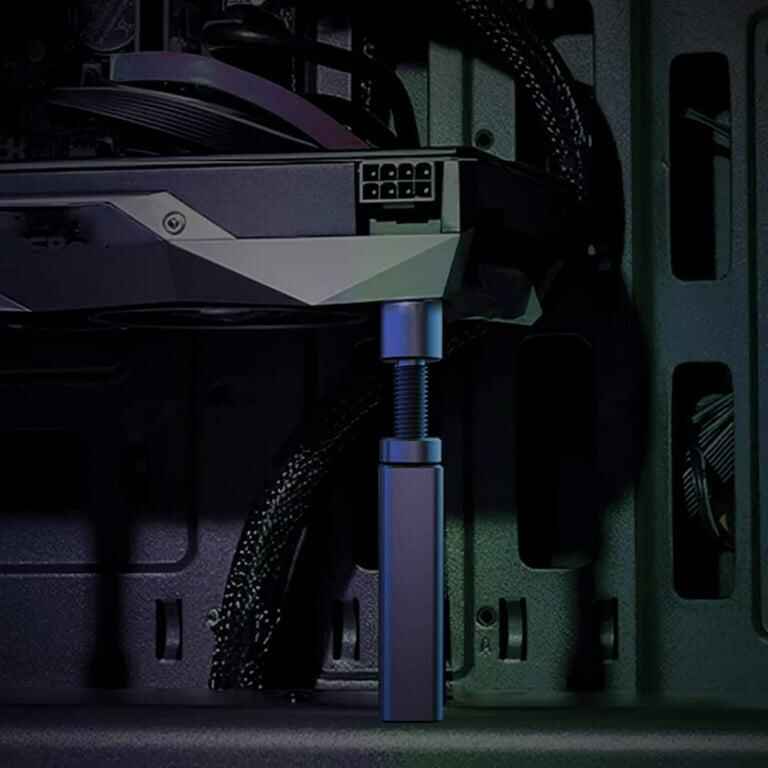
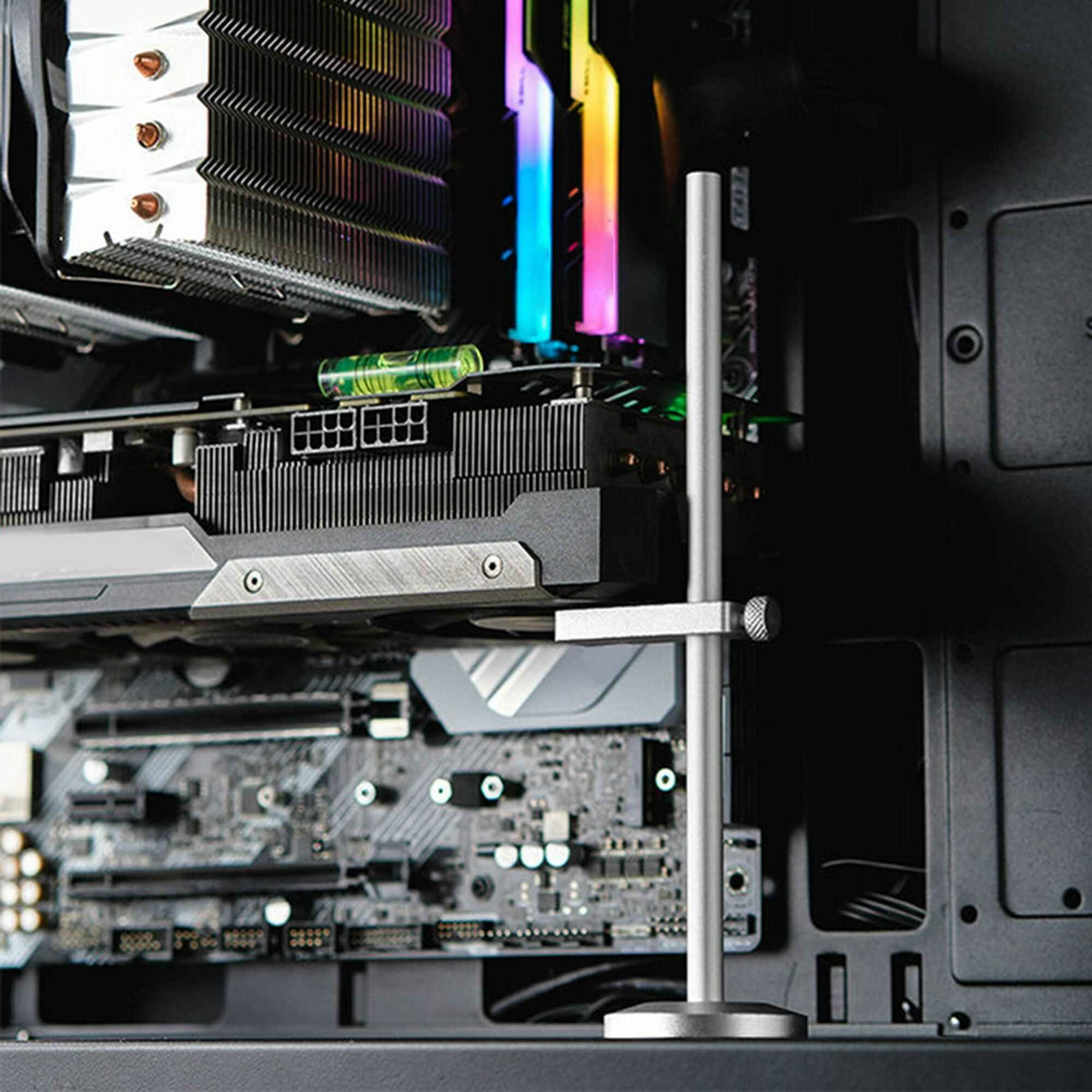
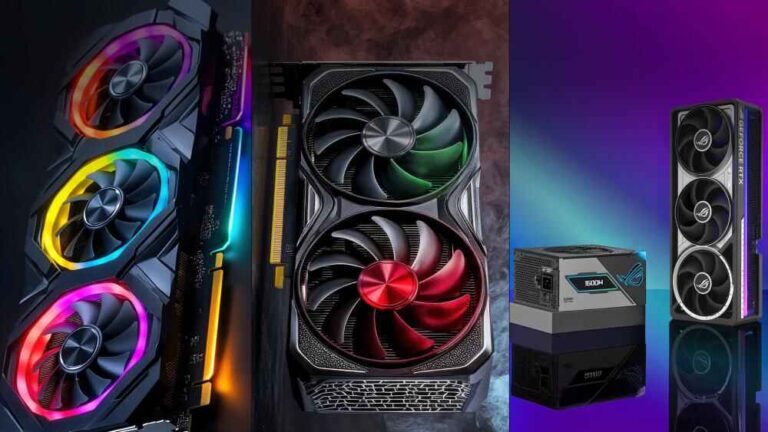
A GPU retention bracket does more than correct visible sag. It creates an additional mechanical load path between a heavy graphics card and the chassis.
Modern GPUs can exceed 2 kg. MSI lists its GeForce RTX 5090 Gaming Trio OC at 2,119 g and 359 mm long, making unsupported leverage a real engineering consideration.
Proper support can reduce unwanted card movement, bending loads, connector stress, and vibration during handling.
Bracket location matters. ASUS recommends supporting a heavy GPU close to its center of gravity to minimize bending and sagging.
Shipping changes the problem entirely. Dell uses dedicated mechanical support to protect graphics cards and PCIe holders during transportation.
For system integrators and chassis buyers, GPU retention should be specified alongside GPU dimensions, PCIe layout, cooling, cabling, and packaging—not added as an afterthought.
Heavy GPUs changed the rules.
A decade ago, many graphics cards could sit horizontally in a system with little discussion beyond securing the rear expansion bracket with a screw. Today, a high-end accelerator may be long, thick, heavily cooled, and heavy enough that its mechanical behavior deserves the same engineering attention as airflow or power delivery.
That is where the حامل تثبيت وحدة معالجة الرسومات (GPU) becomes important.
It looks simple. Sometimes it is just a steel crossmember, adjustable support, card guide, end stop, or reinforced mounting structure. Yet that small component can determine how much of the GPU’s mass is carried by the motherboard, how freely the card can move during transportation, and whether the system remains mechanically consistent after repeated handling.
For an enthusiast PC, visible GPU sag may be annoying.
For an OEM shipping hundreds of systems?
Different problem.
Why GPU Weight Has Become a Mechanical Design Issue
That 2.1 kg mass is not sitting directly above the PCIe connector.
Much of it extends outward.
The farther the card’s mass extends from its mounting points, the more leverage the assembly can place on the PCIe interface, PCB, rear mounting bracket, and surrounding chassis structure.
This is basic mechanics.
A GPU may be electrically connected through the PCIe edge connector and mechanically fastened at the rear expansion slots, but those points do not automatically provide ideal support for every large card geometry.
The chassis therefore needs to answer another question:
Where does the GPU’s weight actually go?
مصممة بشكل جيد Graphics Card Support Bracket gives engineers another point—or several points—through which that load can be transferred into the enclosure.
That changes the mechanical system.
What Does a GPU Retention Bracket Actually Do?
A GPU Support Bracket restrains or supports a graphics card so its weight and movement are not controlled only by the motherboard PCIe slot and rear I/O mounting area.
Depending on the chassis, it may:
support the far end of the GPU;
hold the card vertically or laterally;
locate multiple cards inside a server chassis;
prevent upward or downward movement;
reduce side-to-side motion;
provide additional restraint during shipping;
maintain card spacing;
keep the card aligned with a riser or motherboard slot;
prevent a heavy heatsink assembly from acting like an uncontrolled lever.
The exact design varies considerably between consumer towers, workstations, industrial PCs, and GPU servers.
The principle does not.
Control the mass before the mass controls the system.
How Retention Changes the Mechanical Load Path
Imagine holding a long metal bar from only one end.
Easy with a short bar.
Make it longer and heavier, and suddenly the unsupported end wants to drop. Small movements at the far end generate force back at your hand.
A horizontal GPU behaves in a similar way.
Without secondary support, much of the card’s mechanical load must ultimately be reacted through a relatively small number of interfaces.
Add a properly positioned support point and the load path changes.
System Condition
Without Additional GPU Support
With Proper Retention
Static GPU weight
Concentrated around PCIe/rear mounting area
Shared with chassis support structure
Long-card sag
More dependent on GPU and motherboard stiffness
Better controlled
Handling movement
Card can have greater freedom to move
Movement can be restricted
Transportation shock
Higher potential leverage at mounting points
Load can be distributed across more restraints
Multi-GPU alignment
Depends heavily on slot and card positioning
Easier to mechanically locate cards
Connector alignment
Can shift if the card deflects
More consistent card positioning
Service/reinstallation
Alignment can vary between technicians
Repeatable locating features can help
A bracket cannot magically eliminate every mechanical load.
Nor should it.
The goal is to manage those loads intentionally.
Where Should a GPU Support Bracket Contact the Card?
Placement matters more than many buyers realize.
ASUS’s current graphics-card holder guidance says that as graphics cards become larger and heavier, a holder provides additional reinforcement and helps prevent sagging or bending caused by the card’s own weight. ASUS recommends locating the support point near the upper-right portion of the card, close to its center of gravity, then ensuring the holder contacts a sturdy area of the heatsink housing. ASUS explains the installation approach here(opens in a new tab).
That recommendation highlights an overlooked point.
Simply adding a bracket is not enough.
Put the support in the wrong location and you may still leave a long unsupported span. Apply pressure to a weak plastic shroud and the support itself may cause unwanted deformation. Make the bracket difficult to adjust and assembly technicians may position it inconsistently.
The contact point should be designed.
Not guessed.
بالنسبة لـ GPU Sag Prevention in a custom chassis, engineers should review card dimensions, mass distribution, heatsink construction, motherboard location, riser configuration, available mounting surfaces, and service clearances before freezing the mechanical layout.
The Unpopular View: Reinforced PCIe Slots Are Not the Answer
Here is an unpopular opinion in our industry:
A reinforced PCIe slot does not eliminate the need for proper GPU support.
Reinforcement is useful.
It is not magic.
A stronger slot may improve the local mechanical condition around the motherboard connector, but it does not make the rest of a 300-plus-millimeter graphics card weightless. It does not automatically stop the far end of the card from moving. It does not secure a heatsink during a hard shipping event. And it certainly does not redesign the chassis load path.
Too many builders still look at an anti-sag device as cosmetic hardware.
Straight GPU = job done.
I disagree.
The better question is not:
“Can the PCIe slot hold this GPU?”
It is:
“Where are the loads going during installation, years of operation, servicing, rack movement, and transportation?”
That question forces engineers to think about the entire assembly.
A cheap GPU Anti-Sag Bracket installed wherever there happens to be room may improve appearance, but appearance is not the engineering objective. Stable positioning, repeatable assembly, controlled loading, cooling clearance, and safe service access are.
Shipping Is Where Weak GPU Retention Designs Get Exposed
Static operation is only part of the story.
Shipping can be nastier.
A 2 kg GPU sitting quietly inside a stationary workstation imposes one type of load. That same GPU inside a carton that is tipped, dropped, rolled through a distribution center, loaded onto a truck, unloaded, and moved again experiences a very different mechanical environment.
Dell’s current Alienware Area-51 documentation makes this point unusually clear.
Dell states that, depending on the installed GPU, the system may ship with a midholder designed to prevent damage to both the graphics card and the PCIe holder on the system board during shipping. Dell also notes that RTX 5090-equipped systems use a specially engineered extender that provides additional support and stability instead. Dell documents the system here(opens in a new tab).
That is worth paying attention to.
A major OEM is not adding mechanical restraint because the GPU looks crooked in a product photo.
It is addressing transportation risk.
One Transport-Damage Thread Still Sticks With Me
Recently, while reviewing public PC-building forums, I came across a transport-damage case that should make any system integrator uncomfortable.
The system contained an RTX 3080.
The owner reported that after transportation, the PCIe slot was bent and broken, the GPU’s PCIe connector was heavily scratched, the PCB was bent, and a capacitor had broken off the motherboard. The owner later added that even the anti-sagging bracket had been bent. You can read the original Reddit transport-damage discussion here(opens in a new tab).
That thread is anecdotal. It is not controlled laboratory evidence, and it should not be treated as a published failure-rate study.
Still, the engineering lesson is hard to miss.
The system did not merely have an ugly sagging GPU. Several mechanical interfaces were involved in the damage.
That is why I no longer view retention as a minor accessory discussion.
Once you ship heavy GPUs already installed inside a chassis, mechanical restraint becomes part of packaging and system design.
GPU Retention Is Even More Important in Multi-GPU Systems
One heavy card is manageable.
Now install four.
Or eight.
GPU and AI servers introduce another layer of complexity because card positioning affects more than mechanical appearance. The chassis may need to coordinate GPU spacing with:
high-pressure airflow;
fan walls;
riser cards;
power cables;
network adapters;
motherboard connectors;
adjacent GPUs;
service access;
rack-depth limitations.
The site’s own GPU server application guide identifies GPU weight, support brackets, card spacing, PCIe topology, airflow, and power as part of complete chassis evaluation.
This is the right way to think about it.
A retention system cannot be designed independently from thermal and electrical architecture.
Put a structural bar directly in front of a blower inlet and you may solve one problem while creating another.
Block the removal path for a failed GPU and service time goes up.
Route high-current power cables through the same space required by an adjustable bracket and technicians may start improvising during assembly.
That never ends well.
Four Common GPU Retention Approaches
1. End-Support Brackets
These support the far end of a horizontally installed graphics card.
They are simple and effective when card dimensions are predictable. Adjustable versions can accommodate multiple GPU models, but the adjustment range and locking mechanism need to remain stable.
2. Chassis Crossbars
A horizontal or vertical structural member spans part of the enclosure and supports one or more cards.
This approach makes sense in workstation, industrial, and multi-GPU designs where the chassis manufacturer controls the internal architecture.
A properly engineered crossbar can also provide cable-routing or card-location features.
3. Individual Card Guides or Retainers
These locate each GPU independently.
They are particularly useful where several PCIe cards sit in parallel and spacing must remain consistent.
مخصص PCIe Card Retention Bracket can be integrated into an OEM/ODM chassis rather than added later as a universal accessory.
4. Shipping-Specific Restraints
These may not remain installed while the machine operates.
Their purpose is simple: stop expensive components from moving while the system is in transit.
Removable braces, molded packing inserts, internal foam systems, or temporary retention structures can all play a role depending on the product and shipping method.
Do not confuse operational support with shipping restraint. One bracket may perform both jobs, but that should be verified rather than assumed.
What Should Engineers Specify When Designing a GPU Retention System?
Do not send a chassis supplier a GPU model number and write, “Add support.”
That is too vague.
Give them engineering inputs.
GPU Dimensions
Provide length, height, thickness, connector location, rear bracket dimensions, and any protrusions.
Physical fit should be checked against the actual production GPU or an approved mechanical drawing.
GPU Weight
This matters.
Two cards with similar external dimensions can carry very different cooler assemblies and weight distributions.
Record the mass of every approved GPU option.
Center of Gravity
If this information is available, use it.
If not, engineers can evaluate where support should be placed using representative hardware and mechanical testing.
Number of GPUs
Supporting one card is not the same as locating eight cards.
Multi-GPU systems may benefit from a shared support structure rather than eight independent consumer-style props.
Chassis Orientation
Tower?
Rackmount?
Wallmount?
Vertical GPU?
Horizontal GPU?
Gravity acts the same. The structural load path does not.
هندسة التبريد
A bracket should not choke a fan inlet, interfere with an air shroud, block liquid-cooling tubes, or create a dead zone around a hot accelerator.
Power-Cable Route
Current high-power GPUs can require substantial connector and bend clearance.
Make sure the retention structure leaves the required cable path intact.
Service Procedure
How does a technician remove the GPU?
If servicing requires disassembling half the chassis to reach one bracket screw, the design needs another pass.
Transportation Method
This one gets skipped.
Will the GPU ship installed?
Will the system travel by parcel carrier, pallet freight, air freight, or dedicated rack transport?
Will an integrator remove the GPU before shipment?
Those answers influence the restraint strategy.
What Buyers Should Check During Chassis Prototyping
CAD is necessary.
A prototype is better.
Install the heaviest and longest approved GPU. Install the actual power cable. Populate adjacent cards. Fit the side panel. Verify cooling clearances.
Then look closely.
Does the card visibly deflect?
Does the bracket contact a structurally appropriate surface?
Can the bracket loosen?
Can the card move laterally?
Is there room for assembly tolerances?
Can a technician remove and reinstall the GPU without forcing anything?
Does the card return to the same position after servicing?
Does the support interfere with airflow?
These checks are inexpensive during prototyping.
They become expensive after tooling, production, packaging approval, and shipment.
For projects requiring a purpose-built GPU Support Bracket for PC Case, bracket geometry should be reviewed together with chassis depth, motherboard format, PCIe slots, GPU quantity, cooling hardware, and rack constraints.
Common GPU Retention Mistakes
Treating Sag as the Only Failure Mode
Visible sag is easy to photograph.
Movement is harder to see.
A card can look straight and still have inadequate lateral restraint for shipping or handling.
Supporting a Weak Part of the GPU
Do not assume every part of the fan shroud can carry load.
Support should contact a mechanically appropriate surface.
Making the Bracket Too Rigid Without Considering Tolerance
There is such a thing as over-constraining an assembly.
GPU dimensions, motherboard position, sheet-metal tolerances, and bracket fabrication tolerances all vary.
A design with zero adjustment may create assembly force instead of reducing it.
Forgetting the Power Connector
This happens more often than it should.
The mechanical team creates a beautiful retention structure.
Then the build team discovers there is nowhere to route the GPU power cable.
Forgetting Service Access
Anything installed eventually needs to come out.
Design accordingly.
Assuming One Universal Bracket Supports Every GPU
“Full-height GPU” is not a complete mechanical specification.
Small, light cards may not require secondary support beyond their normal PCIe and chassis mounting arrangement.
The need grows as several factors increase:
card weight;
card length;
cooler mass;
unsupported span;
number of GPUs;
system mobility;
transportation exposure;
vibration;
motherboard orientation;
expected product life.
The decision should come from the application.
Not from fashion.
For B2B Buyers, Retention Should Be Part of the RFQ
If you are sourcing a workstation, industrial PC, AI server, or custom GPU chassis, add mechanical GPU support to the RFQ.
Ask:
Which GPU models have been mechanically validated?
What maximum card weight is supported?
Where is each GPU restrained?
Is the bracket adjustable?
What tolerance range does it accommodate?
Does it interfere with cooling?
Can GPUs be serviced without removing major assemblies?
Does the system require temporary shipping restraints?
Can the supplier test with your actual GPU?
Can the retention design be customized?
Those questions reveal far more than asking whether a chassis has “8 PCIe slots.”
Slots are capacity.
Retention is integration.
The Small Bracket Protects a Much Bigger Investment
A GPU retention bracket will rarely be the most expensive component in a system.
That is precisely why ignoring it makes so little sense.
High-end GPUs now represent substantial mass, thermal hardware, power delivery, and cost concentrated into long PCIe assemblies. Once those cards are placed inside OEM workstations, AI servers, industrial systems, or shipped prebuilt machines, their mechanical support deserves deliberate engineering.
The best retention solution is not necessarily the thickest bracket.
It is the one that puts support in the right place, accommodates manufacturing tolerances, preserves cooling and serviceability, and transfers loads into the chassis without creating new problems.
Small part.
Big job.
الأسئلة الشائعة
What is a GPU retention bracket?
A GPU retention bracket is a mechanical support that helps secure a graphics card inside a chassis and reduces unwanted movement or sag.
It can support the far end of the card, restrain lateral movement, maintain alignment, or provide additional protection during handling and transportation.
Does a GPU support bracket improve system stability?
Yes, when properly designed, it can improve mechanical stability by controlling GPU movement and distributing load into the chassis.
Its effectiveness depends on bracket location, stiffness, GPU weight, chassis design, installation tolerance, and the type of movement the system needs to withstand.
Does a GPU anti-sag bracket protect the PCIe slot?
It can reduce loads that would otherwise be reacted only through the GPU’s primary mounting points, but it does not guarantee PCIe-slot protection.
System stability depends on the complete mechanical design, including the motherboard, chassis, GPU bracket, card structure, packaging, and transportation conditions.
Where should a GPU support bracket be placed?
Support should generally be placed under a mechanically strong part of the card and positioned to reduce the unsupported load.
ASUS recommends placing its holder near the card’s center of gravity and contacting the heatsink housing rather than simply supporting any convenient point.
Are GPU retention brackets necessary for shipping?
Heavy GPUs shipped inside complete systems may require additional restraint, depending on the system and packaging design.
Dell, for example, documents a dedicated midholder intended to protect both the graphics card and motherboard PCIe holder during shipping.
Is a reinforced PCIe slot enough for a heavy GPU?
Not necessarily. A reinforced PCIe slot strengthens one part of the mounting system but does not control every load acting on a long, heavy graphics card.
Large GPUs may still benefit from additional support near the unsupported end or other chassis-level retention.
Should GPU retention be customized for multi-GPU servers?
Often, yes. Multi-GPU systems have tighter requirements for card spacing, airflow, power cabling, serviceability, and mechanical positioning.
A chassis-level retention structure can be more appropriate than individual consumer-style brackets when several accelerators must be installed consistently.
Mark Lee - Founder & Server Chassis OEM/ODM Specialist
Mark Lee is the founder of ISTONECASE, with 20 years of experience in the server chassis industry. He specializes in OEM/ODM solutions for GPU and AI, rackmount, industrial, wallmount, NAS, Mini-ITX and multi-node chassis. His expertise supports customized hardware projects for data centers, AI computing, enterprise storage, edge computing, networking and industrial applications.