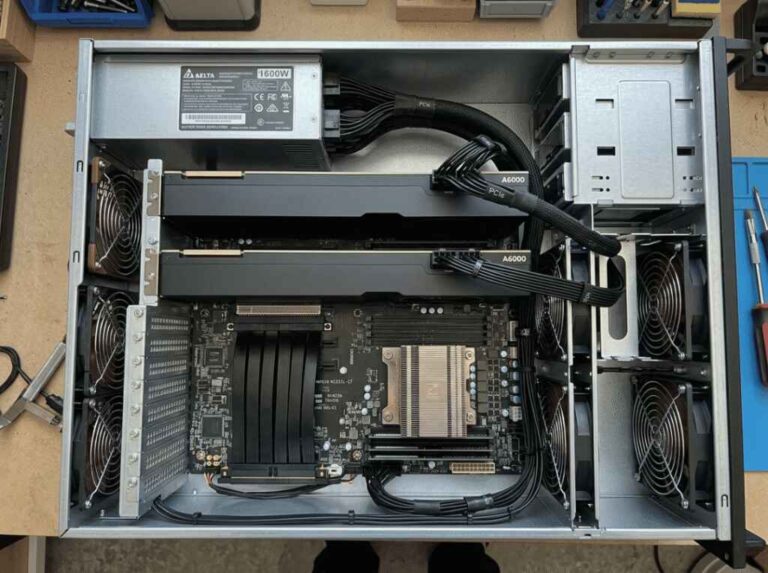
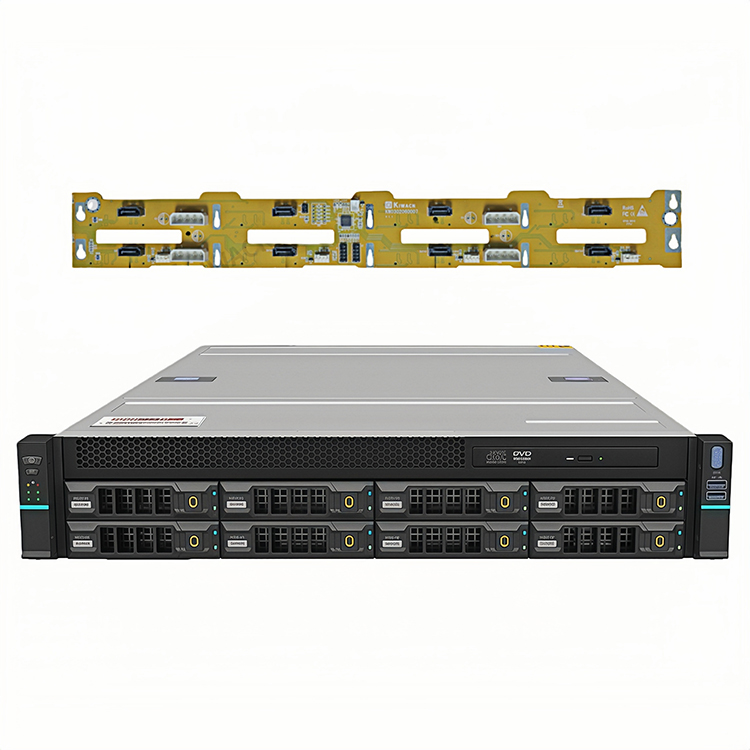
ぜひ弊社まで サーバーシャーシ エンジニアおよび営業チーム




チャンネル登録者数24,000人
お客様の用途、シャーシの種類、ラックの高さ、マザーボード、GPU、ドライブベイ、電源、冷却システム、I/O、および注文数量をお知らせください。当社のエンジニアおよび営業チームが、お客様のプロジェクトに適した標準モデルまたはOEM/ODM構成をご提案いたします。.

A カスタムシャーシの見積依頼 should answer one basic question: Can several qualified manufacturers read this package and price essentially the same product?
If the answer is no, the quotation comparison is already compromised.
That happens more often than buyers expect.
One supplier assumes 1.0 mm SGCC. Another prices 1.2 mm. One includes PEM fasteners and silk-screen printing. Another treats them as extras. One assumes commercial cosmetic quality. Another prices a tightly controlled Class-A exterior finish. Procurement then receives three very different numbers and concludes that Supplier C is “expensive.”
Maybe.
Or perhaps Supplier C was simply quoting the chassis you actually wanted.
That distinction matters, especially now. The July 2026 ISM Manufacturing PMI report reported an average commitment lead time of 87 days for production materials, while capital-expenditure lead times averaged 172 days. Waiting until supplier selection to resolve missing specifications can therefore consume time a program may not have.
A good RFQ prevents that mess before it starts.
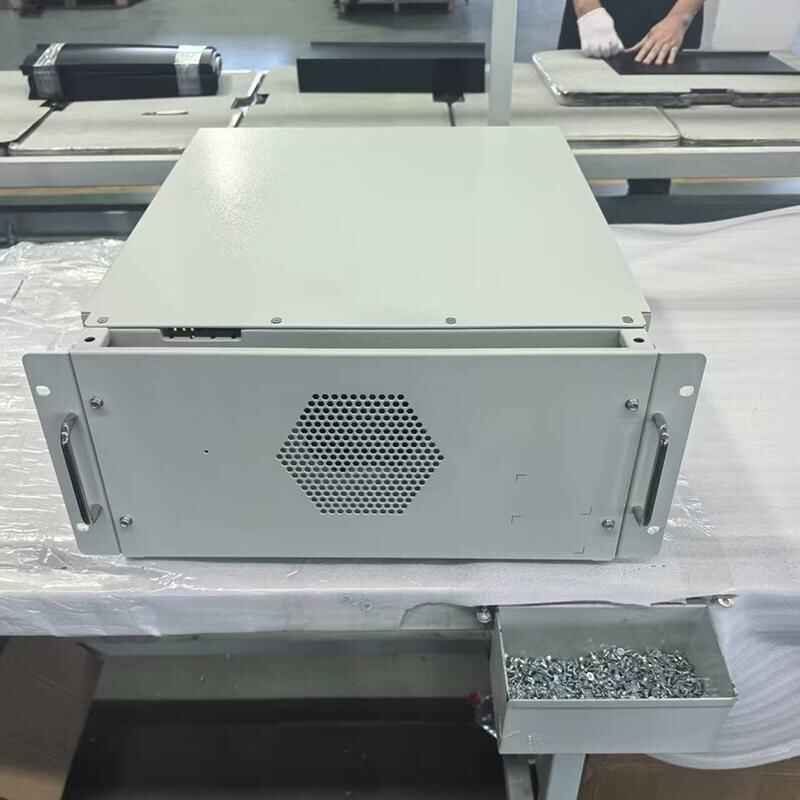
A complete chassis RFQ is a revision-controlled technical and commercial package that tells the manufacturer what must be built, what must fit inside it, what requirements cannot change, how quality will be judged, how many units are expected, and when they are needed.
For a typical rackmount, server, industrial, NAS, GPU, telecom, or electronics chassis project, that usually means supplying:
If you are building your first sourcing package, our Chassis RFQ Checklist can also help you compare the engineering information required for OEM, ODM, and build-to-print chassis projects.
Manufacturers do not quote empty space.
They quote assumptions.
Every unanswered question eventually becomes an assumption about material, process, labor, tooling, inspection, purchased hardware, scrap risk, packaging, or schedule.
Consider how quickly those assumptions pile up.
| RFQ Area | Weak RFQ Input | Quote-Ready Input | Why It Changes Price |
|---|---|---|---|
| 素材 | “Steel chassis” | SGCC, 1.0 mm, approved equivalents stated | Material grade, forming behavior, weight |
| 寸法 | STEP file only | STEP + controlled PDF drawing | Reduces interpretation disputes |
| 公差 | ±0.1 mm everywhere | General tolerance + critical dimensions called out | Inspection and process capability |
| Finish | “Black powder coat” | Color, texture, gloss, masking, cosmetic zones | Pretreatment, coating, handling, rejects |
| Hardware | “Install fasteners” | PEM part numbers and installation locations | Component and insertion cost |
| 冷却 | “Good airflow” | Fan size, quantity, direction, heat load, impedance constraints | Tooling, vents, brackets, fan wall design |
| Quantity | “500 pcs” | 5 prototype / 100 pilot / 1,000 production / 5,000 annual | Tooling strategy and purchasing |
| Quality | “High quality” | Inspection level, CTQs, FAI, reports, cosmetic standard | QC labor and reject exposure |
| パッケージング | “Export carton” | Unit protection, carton count, pallet rules, labels | Materials and freight |
| Schedule | “ASAP” | Prototype date, pilot date, production delivery schedule | Capacity planning and expediting |
This is why the lowest initial number is not always the lowest total cost.
A thin RFQ often produces a thin quote.
The missing costs appear later.
Engineers naturally want to begin with geometry. Procurement often starts with price.
A manufacturer needs both.
Before sending drawings, state what kind of project this actually is.
Is this a five-piece proof-of-concept build? A 100-unit pilot? A 2,000-unit production order? A product expected to consume 20,000 chassis over three years?
Those scenarios may justify very different tooling and manufacturing strategies.
For example, a supplier might accept more manual fabrication for a prototype, use laser cutting and press-brake forming for low-to-medium production, then propose dedicated tooling, fixtures, automated insertion, or process changes once annual demand supports the investment.
So write the volume profile clearly:
Prototype: 5 pcs
EVT/DVT or pilot: 50–100 pcs
Initial production: 500 pcs
Estimated annual usage: 3,000–5,000 pcs
Expected program life: 3 years
Now the manufacturer can think beyond one PO.
That matters in a pricing environment where manufacturers are already watching cost closely. Xometry’s 2026 Manufacturing Outlook reported that 76% of surveyed manufacturers planned price increases in 2026. The survey, conducted with Zogby Strategies in August 2025, included 300 respondents.
Your RFQ should therefore ask for price breaks, not one lonely unit price.
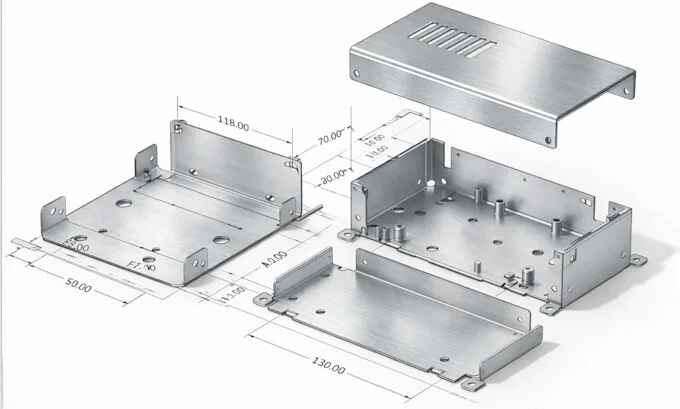
A STEP file is valuable.
It is not the whole specification.
The 3D model communicates nominal geometry extremely well. It helps the estimator see bends, openings, brackets, assemblies, interference risks, and manufacturing complexity.
But a model does not automatically tell the factory:
This is not just theory. In an engineering discussion about sending 2D drawings versus 3D models for RFQs, experienced contributors described sending both PDF drawings and neutral-format STEP models when requesting quotes.
That combination still makes sense.
あなたの Chassis Drawing Requirements should therefore distinguish between geometry-defining information そして manufacturing-defining information rather than trying to force everything into one file.
At minimum, consider showing:
Keep it readable.
That last point is underrated.
Here is the part that sometimes irritates engineering teams:
A more detailed RFQ is not automatically a better RFQ.
I would rather see five dimensions identified as genuinely function-critical than a drawing covered in tight tolerances simply because someone believed ±0.1 mm looks more “engineered.”
Precision has a price.
Tighter requirements may demand better fixtures, slower processing, more inspection, additional measurement equipment, more sorting, more rework, and higher scrap exposure.
Machinists make this point repeatedly. In one discussion about tolerance and manufacturing cost, experienced shop-floor contributors argued for giving manufacturers the widest tolerance that still satisfies the design requirement.
Sheet metal adds another complication: bends interact.
A dimension measured across several bends behaves differently from a laser-cut hole-to-hole dimension on one flat surface. Powder coating adds thickness. Welding adds distortion. A removable lid needs clearance. A motherboard tray needs repeatable standoff positions. A drive cage may need a controlled interface while a hidden flange does not.
So separate dimensions into three buckets:
Function-critical: Tight enough to protect fit or performance.
Assembly-critical: Controlled enough for repeatable production assembly.
Non-critical: Use an appropriate general manufacturing tolerance.
That is better engineering—and usually better buying.
“Metal chassis” is useless.
“Steel chassis” is only slightly better.
A serious Sheet Metal Chassis RFQ should identify the material grade or approved material family, thickness, and whether equivalent substitutions are permitted.
例えば、こうだ:
SGCC steel, 1.0 mm nominal thickness. Alternative galvanized sheet grades require written approval before production.
Or:
5052-H32 aluminum, 1.5 mm, brushed and clear anodized on exterior cosmetic panels.
Why does this matter?
Because two chassis that look nearly identical on a screen can behave differently during bending, welding, coating, grounding, heat transfer, shipping, and long-term service.
Thickness affects stiffness.
Material affects weight.
Finish affects corrosion resistance.
And procurement should know whether the supplier’s attractive quotation assumes the same material you specified—or a cheaper substitution.
If your project starts from an existing rackmount platform rather than a clean-sheet enclosure, compare the available Chassis Manufacturing Specifications before freezing your custom requirements.
This one causes arguments.
Recently, I was browsing a manufacturing forum and came across a buyer complaining that outsourced metal parts had arrived looking so poor that they compared the surface to a failed 3D print.
Then came the uncomfortable question from experienced manufacturing people:
Did the drawing actually specify the surface finish?
について forum discussion captured a problem I see reflected in chassis sourcing all the time: a part can look unacceptable to the buyer yet still be technically close to what the written specification allowed.
That should make every buyer slightly nervous.
Imagine sending a STEP file with this note:
Black powder coated.
Which black?
What texture?
What gloss?
Which surfaces must look perfect?
Can rack ears show fixture marks?
Can the inside show minor coating variation?
Should threads be masked?
Should grounding studs remain uncoated?
Can edges have visible orange peel?
What counts as a reject: scratch, dent, discoloration, exposed substrate, or coating chip?
If those requirements exist only in someone’s head, the manufacturer cannot reliably price them.
A better finish callout might state:
Fine-texture black powder coating, RAL 9005 or approved equivalent, 20–30% gloss. Exterior front panel and top cover are cosmetic surfaces. No exposed substrate, dents, or visible scratches at normal inspection distance. Mask grounding points, PEM threads, and specified chassis-contact areas.
Now the estimator understands the job.
So does QC.
A chassis is not an isolated sheet-metal box.
It is an interface system.
That means your RFQ should identify the hardware the enclosure must accept.
For a server or industrial computing project, that might include:
Do not write “ATX compatible” when you already know the exact board.
Send the board drawing.
Do not write “supports GPU” when the finished system uses four 350 mm accelerators with auxiliary power connectors and heavy support brackets.
Send the GPU envelope.
Specific inputs generate specific quotes.
“Good cooling.”
“High airflow.”
“Optimized thermal design.”
These phrases sound reassuring and tell an engineer almost nothing.
For thermal-sensitive chassis, provide the supplier with the system architecture that drives the cooling problem:
You do not need to dictate every hole pattern if the supplier is performing ODM engineering.
あなた する need to tell them what the finished machine must handle.
That distinction gives the chassis manufacturer room to solve the problem without guessing what the problem is.
PEM studs. Cage nuts. Handles. Latches. Feet. Rails. Dust filters. Fans. Backplanes. Switches. LEDs. Cable assemblies. Drive trays.
Small components add up.
They also create sourcing risk.
Whenever possible, specify one of three states:
Customer-specified part: Use this exact manufacturer and part number.
Approved equivalent permitted: Supplier may propose alternatives subject to approval.
Supplier-selected: Manufacturer may choose a suitable component meeting the stated performance requirements.
This removes another hidden source of quote variation.
If Supplier A includes branded ball-bearing fans and Supplier B assumes generic fans, you are not comparing chassis prices anymore.
You are comparing different BOMs.
“High quality required.”
Delete it.
Everybody says it. Nobody can inspect against it.
A usable quality section tells the supplier exactly what will trigger acceptance or rejection.
That may include:
The economics justify taking this seriously.
について NIST Annual Report on the U.S. Manufacturing Economy: 2025, published in February 2026, cites an IndustryWeek benchmark in which high-performing plants averaged 25,934 defects per million, or 2.6%. The same report cites an earlier NIST Manufacturing Cost Guide estimate placing defect-related losses in U.S. discrete manufacturing between $32.0 billion and $58.6 billion. These figures come from different underlying years, so they should be treated as manufacturing-loss benchmarks rather than a 2026 chassis defect rate.
The lesson is still relevant.
Quality costs money whether you specify it before production or pay for it after production.
The first option is usually easier to manage.
Not every surface needs showroom treatment.
A chassis may have a customer-facing front bezel, a visible top cover, internal brackets nobody sees after assembly, and bottom surfaces hidden inside a rack.
Treating them identically wastes money.
A practical drawing can define:
Class A: Customer-facing cosmetic surface.
Class B: Normally visible but not presentation-critical.
Class C: Internal or hidden functional surface.
Then define allowable defects for each.
This gives production and inspection teams something measurable while avoiding unrealistic expectations on hidden areas.
Compliance questions become expensive when they appear after tooling.
Will the chassis ship as an empty enclosure?
A partially assembled platform?
A finished server?
Those are not necessarily the same regulatory situation.
The RFQ should identify destination markets and request any project-specific documentation you expect, such as:
Do not assume a document that applied to another model automatically applies to your final configuration.
Ask.
Verify.
Archive the evidence with the project revision.
良い カスタムシャーシの見積依頼 makes cost drivers visible.
Request quotation lines for:
| Cost Item | What to Request |
|---|---|
| Prototype | Price and quantity |
| Tooling/NRE | One-time engineering, tooling, fixtures |
| Unit price | Several volume breaks |
| Purchased components | Included or separately itemized |
| 表面処理 | Included or separate |
| Assembly | Included or separate |
| Inspection | Standard vs special reporting |
| パッケージング | Unit, carton, pallet |
| Freight | Incoterm and shipping assumption |
| Samples | Prototype/sample charge |
| Payment | Deposit/balance terms |
| リードタイム | Prototype and production separately |
Now procurement can negotiate intelligently.
This also prevents a classic sourcing trap: selecting a low unit price that carries high NRE, expensive purchased hardware, weak packaging, or costly revision fees.
When you are ready to price a defined project, the Custom Chassis Manufacturing Quote request should include enough technical information for the supplier to separate prototype, tooling, production, and logistics costs instead of returning a one-line estimate.
Do not treat the prototype as an informal sample.
Define its job.
例えば、こうだ:
Prototype approval will verify component fit, rack installation, connector access, airflow architecture, assembly sequence, cosmetic finish, labeling, service access, and critical dimensions. Mass production requires written approval of the revised drawing package and golden sample.
That sentence can prevent an ugly dispute later.
Without it, one side may think the prototype is merely for appearance while the other treats it as the final production baseline.
Also define what happens after prototype changes.
Who owns the CAD?
Who updates drawings?
Does a revision trigger new tooling?
Will the supplier issue a revised BOM?
Will the golden sample be retained?
Questions now are cheaper than arguments later.
RFQ Rev A.
Drawing Rev C.
STEP file dated Tuesday.
Front-panel PDF from last month.
A WhatsApp message asking to move the USB opening 4 mm.
Then the buyer emails a new logo.
Welcome to revision chaos.
It happens fast.
Your RFQ package should use one controlled folder or release package containing the current:
Put the revision directly in filenames where practical.
Then state:
Only documents listed in RFQ release package Rev B are approved for quotation. Any conflicting earlier file, email attachment, or message is superseded.
Boring?
Yes.
Useful?
Extremely.
Here is the other side of over-specification.
Some buyers send RFQs that dictate every bend sequence, weld approach, fixture idea, tooling method, and process step—even when those methods have no effect on the finished product.
That can be a mistake.
If a manufacturing method is required for safety, certification, performance, appearance, or validated process control, specify it.
If not, consider specifying the required result and allowing the manufacturer to propose the production method.
You are buying an acceptable chassis.
Not renting the factory manager’s brain.
A complete RFQ separates what is non-negotiable from what the supplier is allowed to optimize.
That can reveal better DFM ideas, cheaper fabrication methods, simpler assemblies, or more scalable tooling.
Before sending the package, ask yourself:
If you cannot answer several of those questions, expect supplier questions.
That is not necessarily bad. Good manufacturers ask questions.
The danger is the supplier who never asks—and quietly fills every blank with the cheapest reasonable assumption.
For buyers wondering How to Request a Chassis Quote, the best starting point is not “What is your price?” It is “Here is the system we need to build, here are the controlled requirements, and here is where you have engineering freedom.”
That changes the conversation.
Instead of comparing random numbers, you start comparing manufacturing solutions.
Send drawings, material, thickness, tolerances, finish, component interfaces, cooling requirements, quantities, quality requirements, packaging, destination, and requested delivery dates.
The goal is to give each supplier enough information to quote the same scope and identify any engineering assumptions before pricing is finalized.
Send both whenever possible.
The STEP model communicates nominal geometry, while the 2D drawing controls tolerances, material, finish, critical dimensions, hardware, inspection notes, cosmetic requirements, and revision information.
Include prototype, pilot, initial production, and estimated annual quantities separately.
Multiple volume levels allow the manufacturer to propose suitable tooling, purchasing, assembly, and manufacturing methods and give procurement useful price breaks.
Specify tight tolerances only where fit, function, alignment, or assembly requires them.
Use an appropriate general tolerance elsewhere. Unnecessarily tight requirements can add process control, inspection time, rework, and scrap without improving the finished product.
Define color, texture, gloss, cosmetic areas, masking points, grounding areas, and acceptable visual defects.
“Black powder coat” leaves too much room for interpretation. If appearance matters, define what the supplier and inspector should consider acceptable.
No. Specify mandatory processes only when they affect performance, validation, compliance, appearance, or reliability.
Where the manufacturing method does not matter, define the required result and allow qualified suppliers to propose an efficient production method.
Different prices often reflect different assumptions, not simply different margins.
Material, thickness, tolerances, finish, hardware, inspection, packaging, tooling, quantities, and delivery terms can all change the price. A better-controlled RFQ reduces those hidden assumptions.
Prototype before volume production whenever fit, airflow, assembly, appearance, or new tooling carries meaningful risk.
Use the prototype to verify the complete system, record revisions, and establish an approved golden sample before releasing mass production.

Comments